
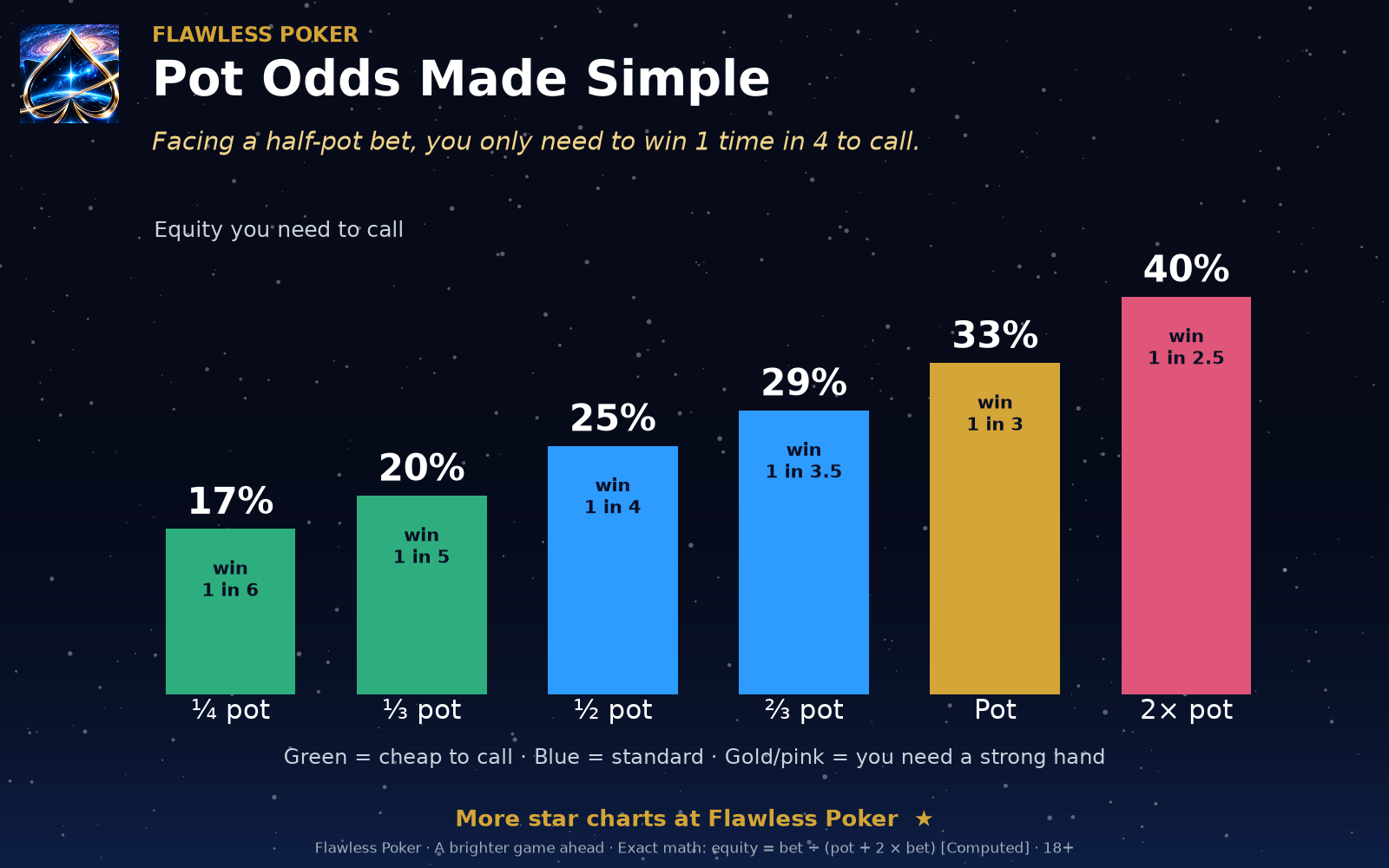
Required equity is how often a call must win to break even when this bet closes the hand: the call divided by the pot after you call. For a bet of size B into a pot P, that is B ÷ (P + 2B).
A pure bluff, one that wins nothing when called, needs folds of B ÷ (P + B). Minimum defense frequency is the rest: the share of a range that must continue so that pure bluff does not profit by itself. It is a benchmark against mindless bluffs, not a rule that every continuing hand must be played.
| Bet into the pot | Call needs | Minimum defense | Pure bluff needs |
|---|---|---|---|
| Quarter pot | 16.7% (1/6) | 80% | 20% |
| One-third pot | 20% (1/5) | 75% | 25% |
| Half pot | 25% (1/4) | 66.7% | 33.3% |
| Two-thirds pot | 28.6% (2/7) | 60% | 40% |
| Three-quarter pot | 30% (3/10) | 57.1% | 42.9% |
| Full pot | 33.3% (1/3) | 50% | 50% |
| One and a half pot | 37.5% (3/8) | 40% | 60% |
| Twice pot | 40% (2/5) | 33.3% | 66.7% |
Implied odds are future money, and they are an estimate.
Implied odds are chips you expect to win on later streets when you hit. They can make a call reasonable when the immediate price is a little short. They are not a number the deck gives you.
You call 10 into a pot that is already 30, so you need 10 ÷ 40, which is 25%, if the call ends the hand. You have 9 clean outs and only the river is left: 9 ÷ 46 is 19.6%. The call wants about (10 ÷ 0.196) − 40, roughly 11 more chips of future winnings, on average, before it breaks even. The 10, the 30, and the single street are an example. The division is exact for those inputs.
Pot odds made simple
These counts are for study and post-session review. Where a row comes from a simulation, the caption names how many deals were run. Where a stack or a pot is made up, the caption says so. None of these figures is an instruction for a live pot.