
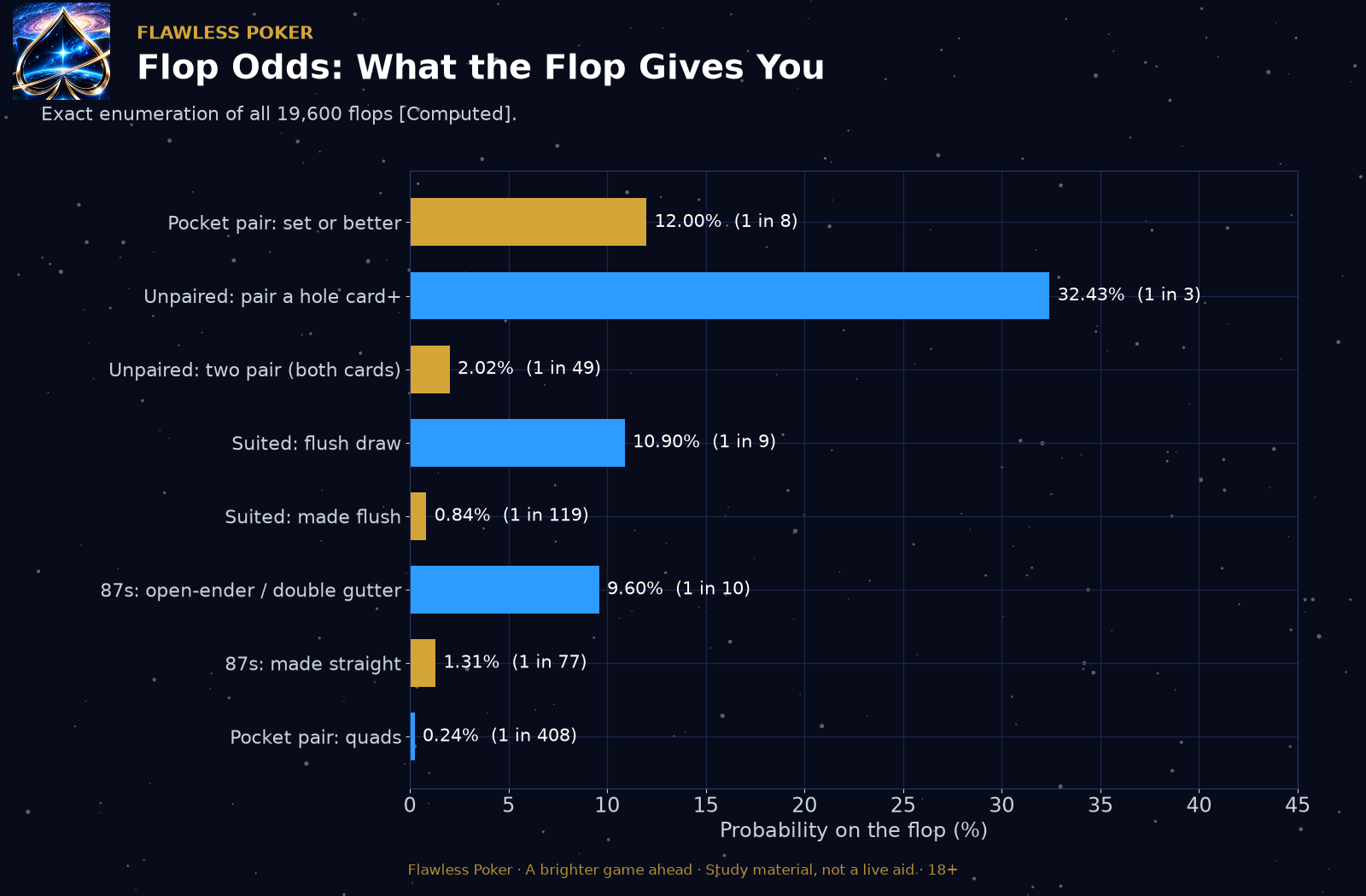
After two hole cards are known, 50 cards remain. The flop count is 50 × 49 × 48 ÷ 6. Some flops fit more than one description, so the rows are not added together. A suited hand and an unpaired hand are different starting points.
| Event | Flops | Chance | Plain English |
|---|---|---|---|
| Pocket pair flops a set or better | 2,304 | 11.76% | 1 in 8.5 |
| Pocket pair flops exactly a set | 2,256 | 11.51% | 1 in 8.7 |
| Pocket pair flops quads | 48 | 0.24% | 1 in 408 |
| Suited hand flops a flush | 165 | 0.84% | 1 in 119 |
| Suited hand flops a four-card flush draw | 2,145 | 10.94% | 1 in 9.1 |
| Suited hand flops exactly one of its suit | 8,151 | 41.59% | 1 in 2.4 |
| Unpaired hand pairs at least one hole card | 6,356 | 32.43% | 1 in 3.1 |
| Unpaired hand makes exactly one pair, and it is a hole card | 5,280 | 26.94% | 1 in 3.7 |
| Unpaired hand flops two pair with both hole cards | 396 | 2.02% | 1 in 49 |
| Seven-six flops a straight | 256 | 1.31% | 1 in 77 |
| Seven-six flops an open-ended straight draw | 1,776 | 9.06% | 1 in 11 |
Exactly a set means one of the two remaining cards of that rank, not both. Both of them is quads, 48 flops. The two-pair row is one card of each hole rank plus a blank. Pairing both ranks in a fuller way, including trips with a pair, is a slightly larger set of boards. An open-ended straight draw here means four cards in a row with both ends still live, not every board that happens to have eight outs.
If you hold no ace, an ace appears on the flop on 4,420 of the 19,600 boards, 22.6%. Holding pocket kings, that is the ace you do not want to see.
What the flop gives you
How often a pocket pair hits
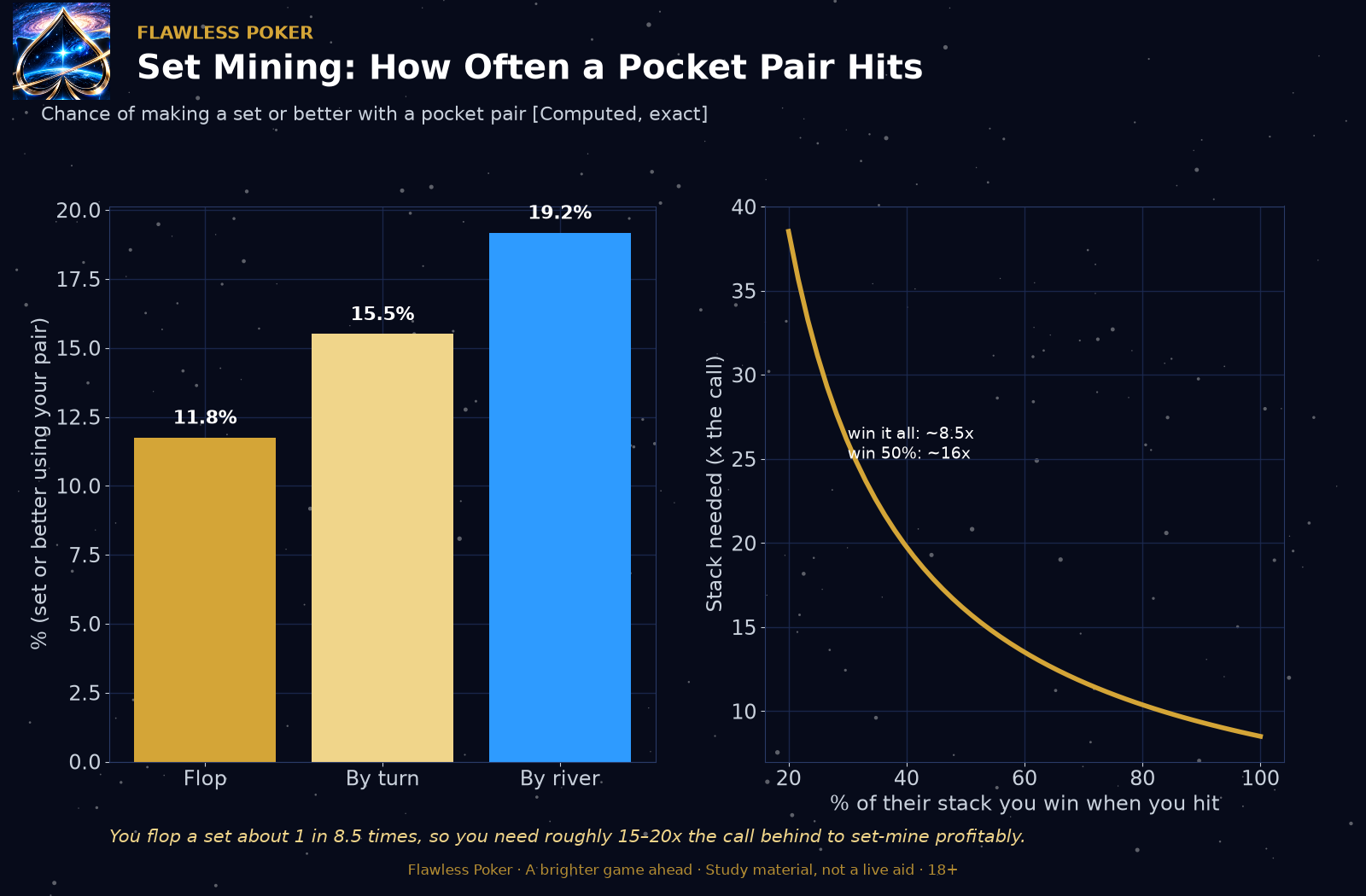
These counts are for study and post-session review. Where a row comes from a simulation, the caption names how many deals were run. Where a stack or a pot is made up, the caption says so. None of these figures is an instruction for a live pot.