
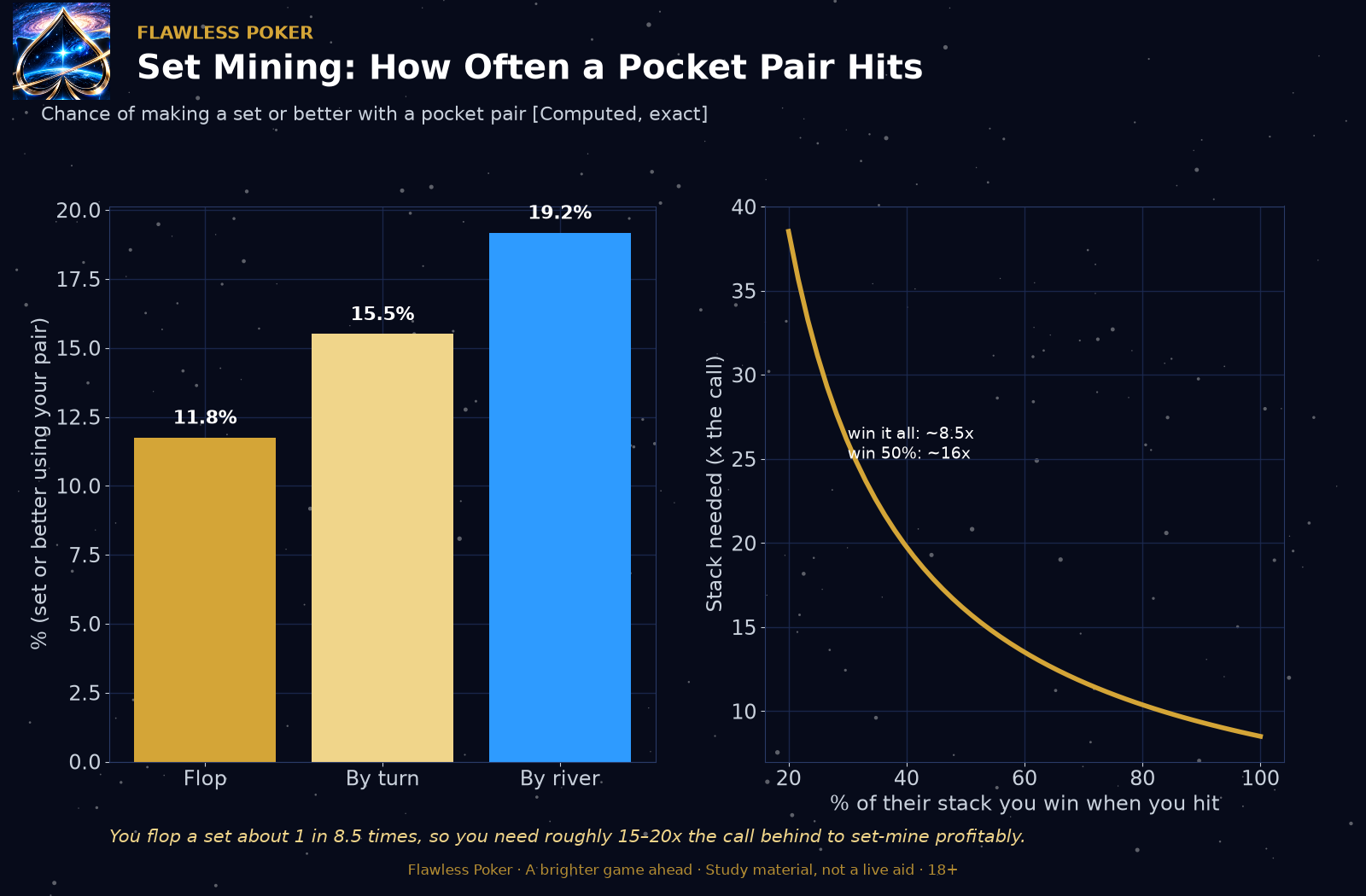
A pocket pair flops a set or quads on 2,304 of 19,600 flops, 11.76%, about 1 in 8.5. If the only plan is to call before the flop, fold every miss, and get paid every time the set arrives, the hit has to return about 7.5 times the call to break even. That 7.5 is (1 − 0.1176) ÷ 0.1176.
The call size and the always-fold-when-you-miss plan are an example. Sets sometimes lose. The other player does not always pay. The stacks cap what can be won. A commonly quoted guide asks for effective stacks of roughly 15 to 20 times the call before that pure mine is even in the conversation. The guide is a rule of thumb. The 11.76% and the 7.5 are the arithmetic.
How often a pocket pair hits
These counts are for study and post-session review. Where a row comes from a simulation, the caption names how many deals were run. Where a stack or a pot is made up, the caption says so. None of these figures is an instruction for a live pot.