
Fifty-two cards, two at a time.
Order does not matter, so the count of starting hands is 52 × 51 ÷ 2. Players then collapse those 1,326 combinations into 169 classes: 13 pairs, 78 suited hands, and 78 offsuit hands. A class is a name. The deck deals combinations, and an offsuit hand has three times as many as a suited hand.
| Fact | Value |
|---|---|
| Distinct two-card starting hands | 1,326 (52 × 51 ÷ 2) |
| Strategic hand classes | 169 (13 pairs + 78 suited + 78 offsuit) |
| Combos of one pocket pair | 6 |
| Combos of one suited hand | 4 |
| Combos of one offsuit hand | 12 |
| Possible flops after your two cards | 19,600 |
| Possible five-card boards after your two cards | 2,118,760 |
| Boards in a heads-up all-in, four cards known | 1,712,304 |
How often the deck offers a hand.
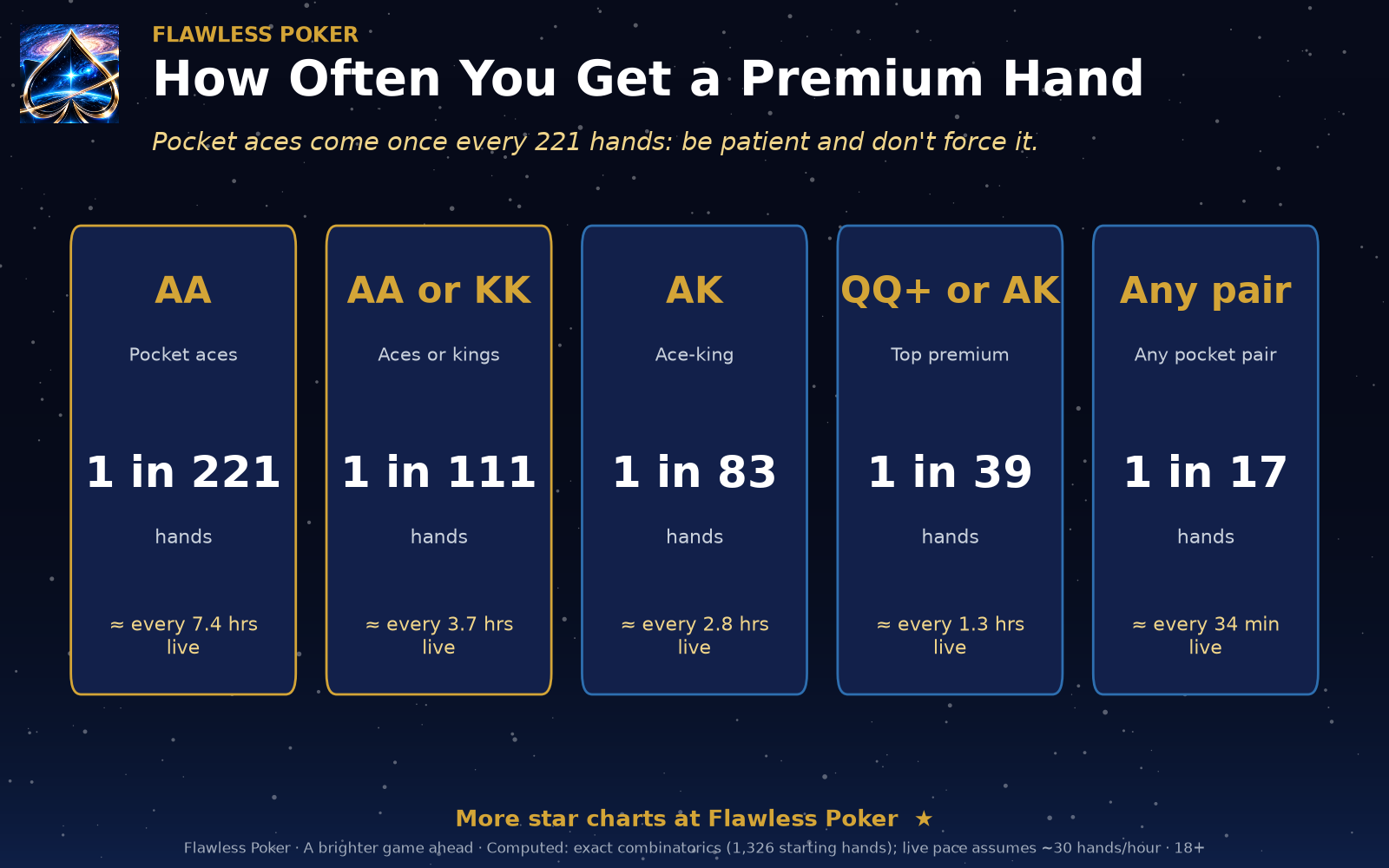
These are chances per hand dealt to you, before anyone acts. Pocket aces twice in a row is 1 in 221, squared: 1 in 48,841.
| Hand | Combos | Chance | Plain English |
|---|---|---|---|
| Any pocket pair | 78 | 5.88% | 1 in 17 |
| One specific pair, such as aces | 6 | 0.45% | 1 in 221 |
| Ace-king, either suit pattern | 16 | 1.21% | 1 in 83 |
| Ace-king suited | 4 | 0.30% | 1 in 332 |
| Ace-king offsuit | 12 | 0.90% | 1 in 110.5 |
| Any suited hand | 312 | 23.53% | 1 in 4.3 |
| Any hand with an ace | 198 | 14.93% | 1 in 6.7 |
| Queens or better, or ace-king | 34 | 2.56% | 1 in 39 |
| Jacks or better, or ace-king | 40 | 3.02% | 1 in 33 |
| Tens or better, or ace-queen | 62 | 4.68% | 1 in 21 |
| Two broadway cards, ten through ace, pairs included | 190 | 14.33% | 1 in 7.0 |
| Suited connectors, 32s through AKs | 48 | 3.62% | 1 in 28 |
Pairs 5.9% Suited 23.5% Offsuit 70.6%
Is there a bigger pair out there?
You look down at a pocket pair. This is the chance that at least one other seat at a full table holds a higher pocket pair. Kings can only be outrun by aces. Queens can be outrun by aces or kings. The count runs over every way the remaining cards can reach the other seats.
| Your pair | 6-max, five opponents | 9-max, eight opponents |
|---|---|---|
| Kings | 2.44%, about 1 in 41 | 3.91%, about 1 in 26 |
| Queens | 4.84%, about 1 in 21 | 7.67%, about 1 in 13 |
| Jacks | 7.18%, about 1 in 14 | 11.29%, about 1 in 8.9 |
| Tens | 9.47%, about 1 in 11 | 14.77%, about 1 in 6.8 |
At a full 9-handed table, at least one player is dealt a pocket pair about 41.9% of the time. That figure is a simulation of 500,000 deals, not a closed-form count.
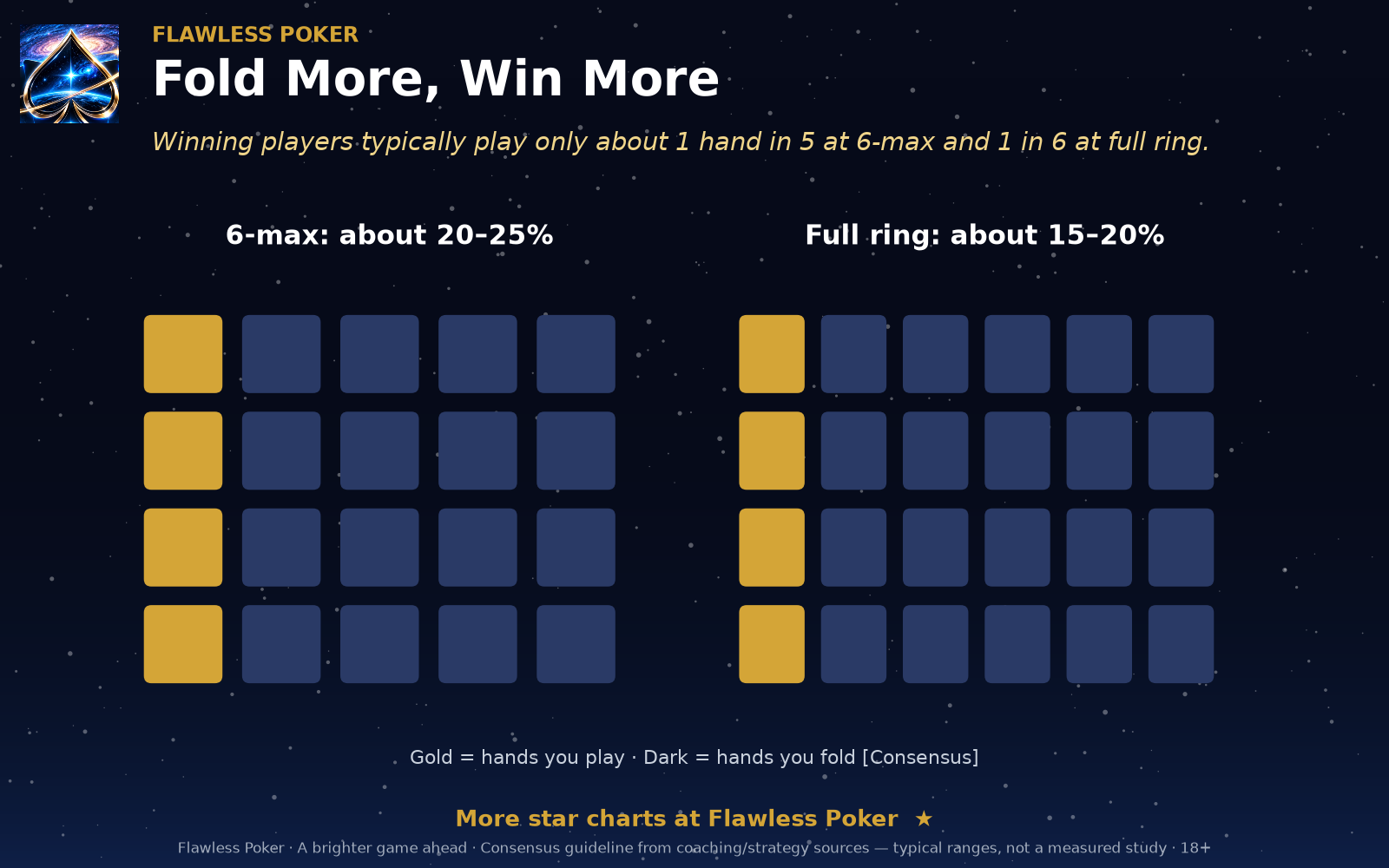
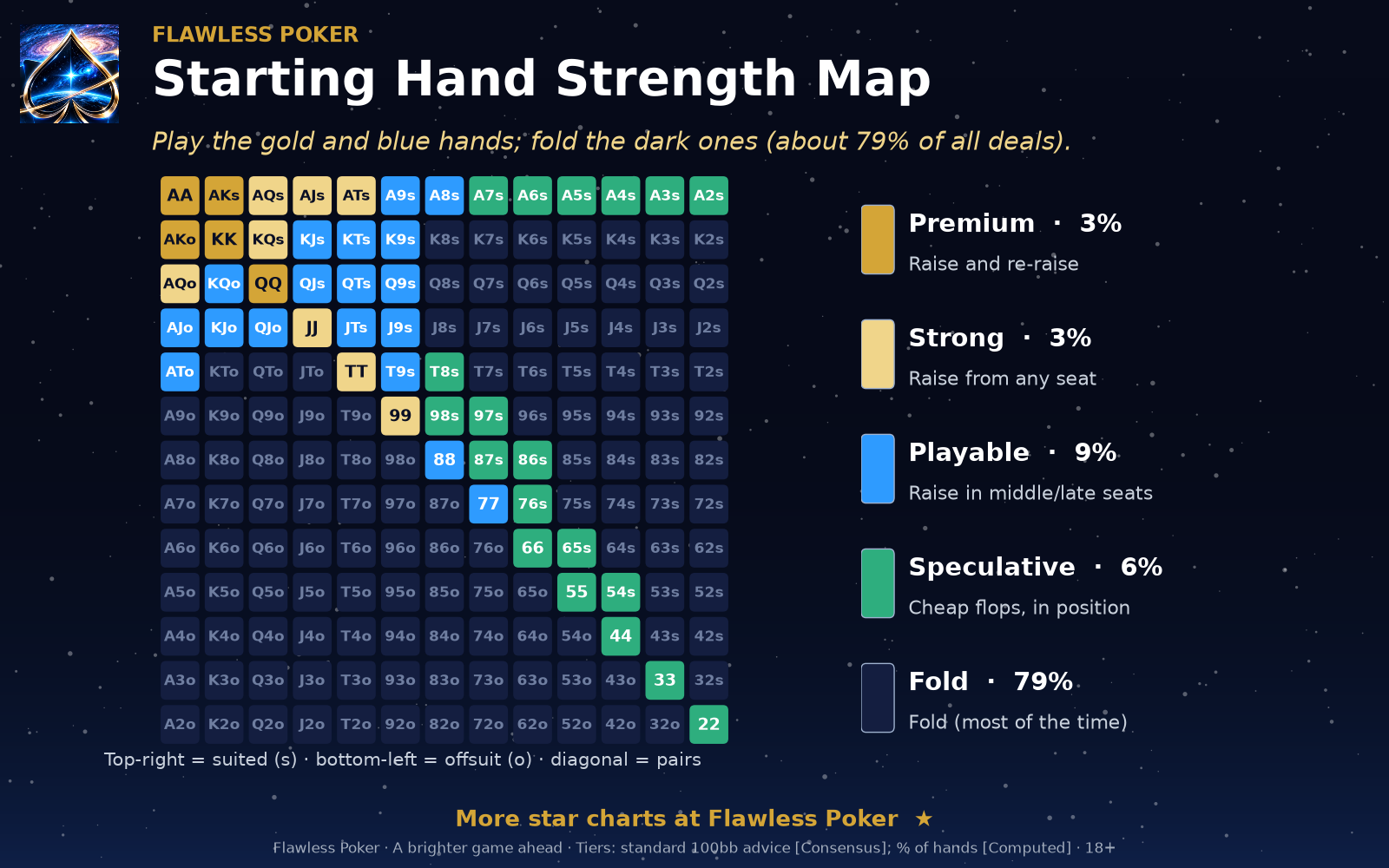
The button acts last on the flop, turn, and river. Early position has more players left to act. The color grid below is one fixed example for about 100 big blinds. It is not an opening law for every chair, stack, or table. The selectivity picture is a coaching sketch of the same idea: most hands are folded, and a full ring folds more than a six-max game.
How often you get a premium hand
Starting-hand selectivity by table size
One starting-hand strength map
These counts are for study and post-session review. Where a row comes from a simulation, the caption names how many deals were run. Where a stack or a pot is made up, the caption says so. None of these figures is an instruction for a live pot.