
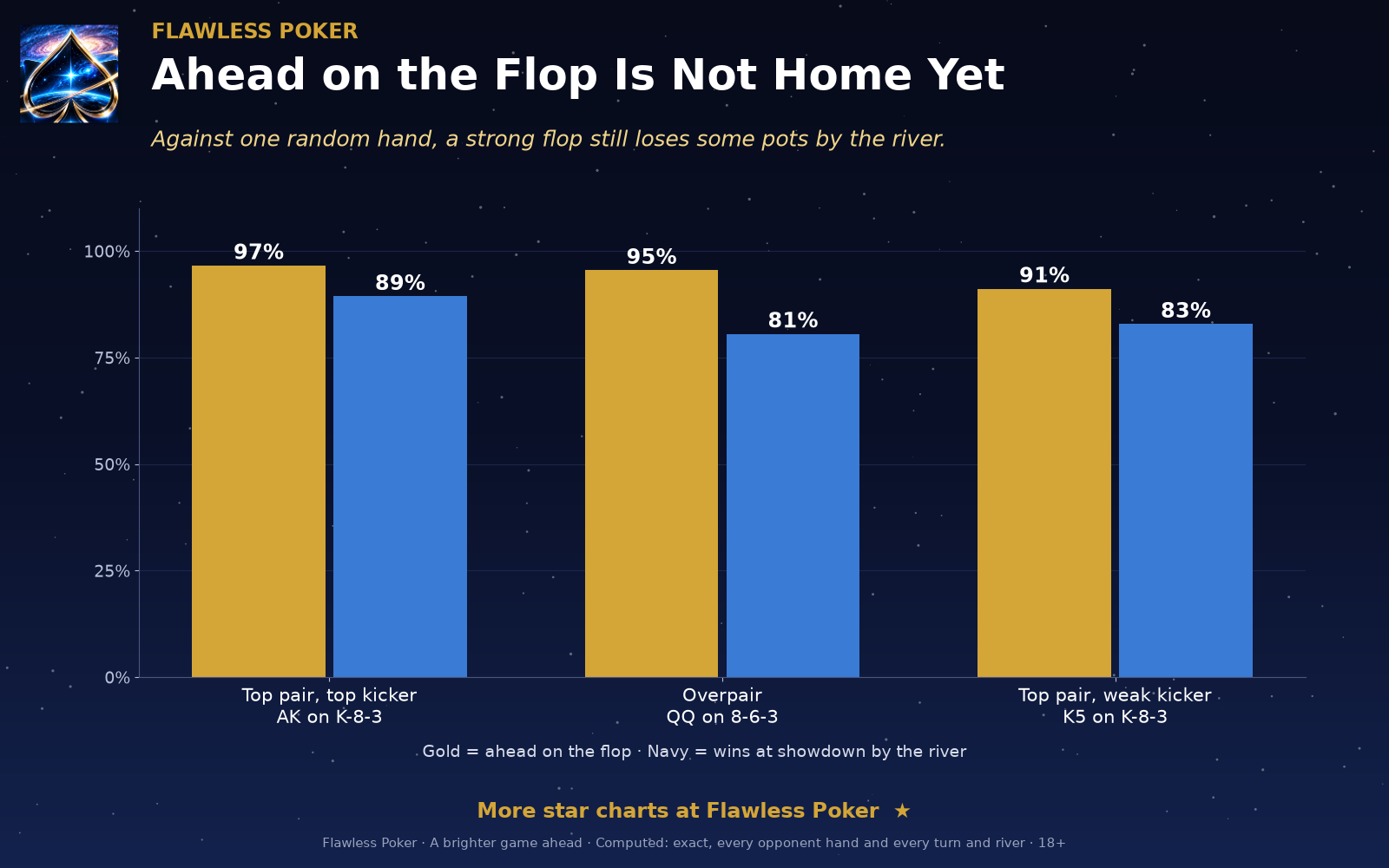
Each row deals every possible hand to one opponent (1,081 of them) and then every turn and river (990 each). The first number asks who is ahead on the flop. The second asks who has the pot at showdown.
| Your hand on the flop | Ahead on the flop | Wins by the river | Ties | Equity |
|---|---|---|---|---|
| Top pair, top kicker: As Kd on Kh 8c 3d | 96.6% | 89.3% | 0.6% | 89.7% |
| Overpair: Qs Qh on 8c 6d 3h | 95.5% | 80.5% | 0.1% | 80.6% |
| Top pair, weak kicker: Kd 5d on Kh 8c 3s | 91.1% | 82.8% | 2.5% | 84.1% |
Against one random hand, the overpair is ahead on 95% of flops, but it holds to the river only about 81% of the time. Of the hands behind on the flop, about 1 in 6 catch up by the river.
When the other hand is a pocket pair.
Take Qs Qh on 9c 6d 2h, and suppose the opponent holds some pocket pair. 64 pocket-pair combinations are still possible. 9 of them are sets (nines, sixes or deuces, 3 combinations each). That is 14.1%, about 1 in 7.1.
| Matchup on 9c 6d 2h | Queens equity |
|---|---|
| Qs Qh vs 9s 9h (set) | 8.6% |
| Qs Qh vs Js Jh (underpair) | 91.6% |
Real opponents do not hold random hands. Their actions narrow the range. These rows measure the deck before any of that, as a baseline for review between sessions.
Ahead on the flop is not home yet
These counts are for study and post-session review. Where a row comes from a simulation, the caption names how many deals were run. Where a stack or a pot is made up, the caption says so. None of these figures is an instruction for a live pot.