
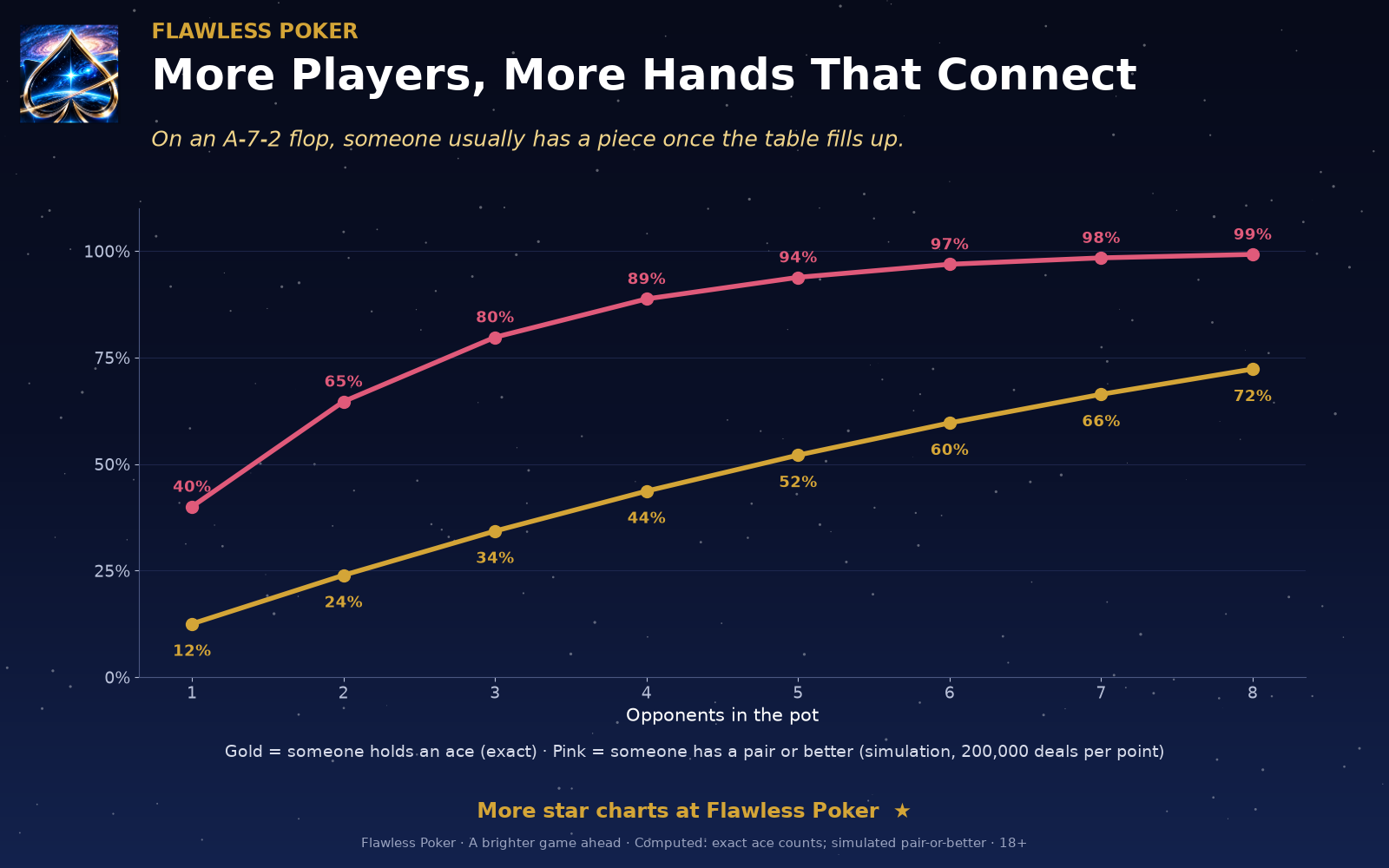
The board is Ah 7d 2s and you hold 9c 8c, so 3 aces are left among the 47 unseen cards. The ace column is exact hypergeometric counting. The pair column checks each opponent for a pocket pair or a card matching the board.
| Opponents | Holds an ace before the flop (you hold none) | Holds an ace on Ah 7d 2s | Has a pair or better on Ah 7d 2s |
|---|---|---|---|
| 1 | 15.5% | 12.5% | 40.0% |
| 2 | 29.1% | 23.9% | 64.6% |
| 3 | 41.1% | 34.3% | 79.7% |
| 4 | 51.4% | 43.6% | 88.7% |
| 5 | 60.3% | 52.1% | 93.8% |
| 6 | 67.9% | 59.6% | 96.9% |
| 7 | 74.4% | 66.4% | 98.4% |
| 8 | 79.9% | 72.3% | 99.2% |
Heads-up, an ace is out there about 1 in 8.0. With eight opponents it is 72%, and someone has at least a pair 99% of the time.
FLAWLESS POKER / STUDY CHART
More players, more hands that connect
These counts are for study and post-session review. Where a row comes from a simulation, the caption names how many deals were run. Where a stack or a pot is made up, the caption says so. None of these figures is an instruction for a live pot.